The genre
What is a real-time card battler?
A real-time card battler is a strategy game where your cards become units on a battlefield, both players play at once, and a match is over in a few minutes. Clash Royale made the format famous in 2016. This is how the genre works and what separates a good one from a reskin.
The five parts
Every game in the genre is built from the same five pieces. Change one and you have a different genre.
- A small deck you build beforehand. Usually six to ten cards. Small enough that you see most of it every match, so every card matters.
- A resource that refills in real time. Elixir, energy, gold. You cannot play everything, and waiting is a decision.
- Cards that become units. You choose where and when a card lands. After that the unit acts on its own: it walks, picks a target and fights.
- A battlefield with lanes and bases. Units travel toward the enemy's structures. Lanes force you to choose where to attack and where to defend.
- A short clock. Three minutes is typical, with the resource rate rising near the end so matches finish decisively.
How it differs from its neighbours
| Genre | Who acts when | What you control | Match length |
|---|---|---|---|
| Real-time card battler | Both players, continuously | What to place, where and when | 3–5 minutes |
| Collectible card game | One player at a time | Every card and every attack | 10–20 minutes |
| Real-time strategy | Both players, continuously | Every unit, building and worker | 15–40 minutes |
| Tower defence | You, against scripted waves | What to build and where | Varies |
| Auto-battler | Everyone, between rounds | Your line-up, not the fight | 20–40 minutes |
A card battler takes the deck from card games and the live battlefield from real-time strategy, and leaves out the part of each that takes longest to learn: there are no long combo turns, and no micromanaging individual units.
The skills it rewards
Resource counting
If you spend four energy to destroy something that cost your opponent six, you are two ahead. Stack up enough small wins like that and you can afford a push they cannot answer. Good players track roughly how much the other side has at every moment.
Placement
The same card is strong or useless depending on where it lands: in front of a fragile unit or behind it, in the lane being attacked or the empty one, close enough to help or too far back to matter.
Timing
Launching a defender two seconds too early means it fights alone. Launching support two seconds too late means the unit it was supporting is already dead.
Reading the opponent's deck
With a small deck, you learn what your opponent is holding within the first minute. From then on you know what answers they have and when those answers are out of their hand.
How Skyfire builds one
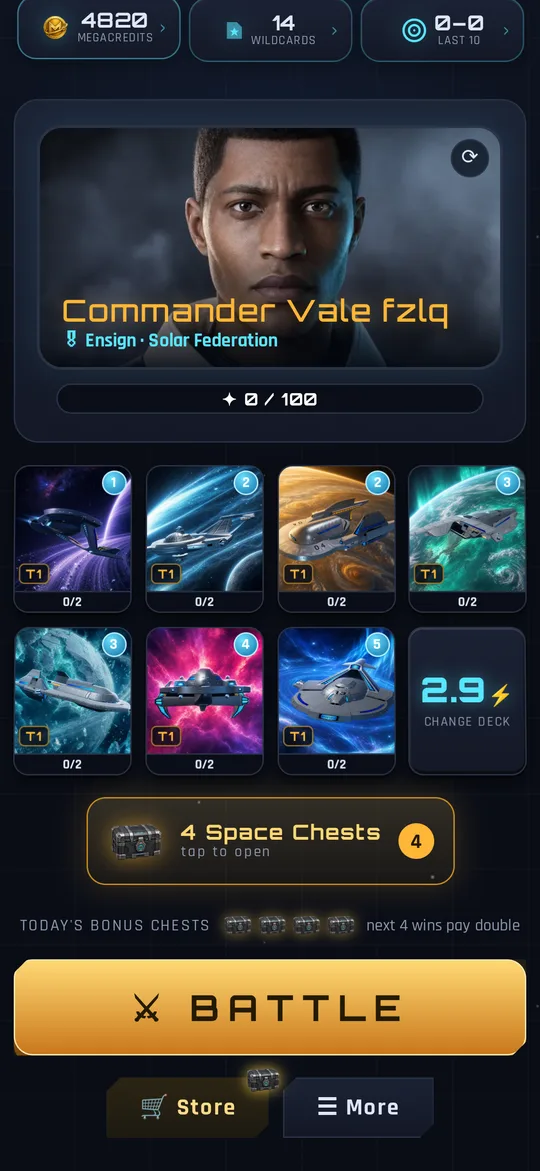
VGA Planets: Skyfire is a real-time card battler made of starships. The five parts look like this:
- Deck: seven ships, plus a starbase that is always in play. Seven from one of twelve races.
- Resource: energy, refilling up to 10. You start a battle with some already banked.
- Units: over 120 ship hulls, from one-energy scouts flying three abreast to eight-energy capital ships.
- Battlefield: two lanes crossing a central trench by jump-gate bridges, with an asteroid field in the middle. Each side has a starbase and a homeworld.
- Clock: three minutes, double energy for the final minute, then sudden-death overtime.
What Skyfire adds to the formula
Asymmetric races
Most games in the genre have one card pool. Skyfire has twelve, and you build a deck from one. A race is a rule as much as a roster: cloaking, self-repair, web mines, double beam weapons, pods that land anywhere. See all of them.
An economy on the board
Freighters fly to ore deposits in the asteroid field and haul fuel home for bonus energy. They are unarmed and slow. Whether to run them, and how hard to hunt the enemy's, is a decision in every match.
Information warfare
Cloaked ships are invisible until they fire. One ship, the Loki, prevents every enemy ship from cloaking for as long as she survives. Minefields sit unseen until something strikes them. A lot of Skyfire is about what your opponent can and cannot see.
Weapons with ranges
Beams are short-range and instant. Torpedoes reach much further and take time to arrive. Carriers stand off and launch fighters. A fleet that mixes them correctly gets to shoot first.
Questions people ask
What is the difference between a card battler and a card game?
In a traditional card game you play cards in turns and resolve their effects yourself. In a real-time card battler a card becomes a unit on a live battlefield, both players play at the same time, and the units fight on their own.
What was the first real-time card battler?
Clash Royale, released by Supercell in 2016, is the game that defined the format and that most others are compared with.
Are real-time card battlers hard to learn?
No. The basic loop — wait for energy, tap a card, tap the board — takes about a minute to learn. The depth comes from deck building, timing and reading your opponent.
Can I play a real-time card battler on a computer?
Yes. Skyfire runs in a web browser with nothing to install, as well as on Android and iOS.