Deck building
Deck-building strategy games: the three kinds, and which one Skyfire is
People use "deck-building game" for three quite different things. If you are looking for one of them and land on another, you will be disappointed. So first the three kinds, then exactly where Skyfire fits.
The three kinds
1. Deckbuilders: you build the deck during the game
You start with a weak handful of cards and buy or draft better ones as you play. Building the deck is the game. Dominion started it on the tabletop; Star Realms and Ascension carry it on in digital form; Slay the Spire turned it into the single-player roguelike deckbuilder that a whole wave of games followed.
2. Collectible card games: you build the deck before the game
You own a collection, construct a deck of thirty to sixty cards from it, and then play it turn by turn. Magic: The Gathering, Hearthstone and Legends of Runeterra are the well-known ones. The deck building is deep and happens between matches; a match is a test of the deck.
3. Card battlers: a tiny deck, played in real time
You still build before the match, but the deck is under ten cards and it is played on a live battlefield where cards become units. Clash Royale is the reference point. Deck building is tighter, because with so few slots every inclusion pushes something else out.
| Deckbuilder | Collectible card game | Card battler | |
|---|---|---|---|
| Deck is built | During the match | Before the match | Before the match |
| Deck size | Grows as you play | 30–60 cards | 6–10 cards |
| Play | Turn-based | Turn-based | Real-time |
| Usual mode | Often solo | Player-versus-player | Player-versus-player |
| Session | 10–60 minutes | 10–20 minutes | 3–5 minutes |
| Examples | Slay the Spire, Star Realms | Hearthstone, Magic | Clash Royale, Skyfire |
Skyfire is the third kind
Skyfire is a competitive card battler. You build a deck of seven ships from your collection, then take it into real-time battles against other players. If you wanted a single-player roguelike, this is not it. If you want deck building where every slot hurts and you find out in three minutes whether you were right, read on.
What deck building looks like here
The constraints
- Seven cards. Your starbase is always in play and does not take a slot. One more slot opens much later, when you reach Fleet Admiral with that race.
- One race per deck. You build from one of twelve rosters of roughly twenty cards each.
- One copy of each card. No stacking three of your best ship.
- A hand of four. With seven cards, your whole deck comes round quickly, so a dead card is dead often.
The questions every deck has to answer
A deck is seven answers to a fixed set of questions. You do not need a separate card for each, but you do need an answer to each:
- What do I play in the first ten seconds?
- What actually destroys a homeworld?
- What stops a swarm of cheap ships? What stops one enormous one?
- What do I do about ships I cannot see?
- Am I running freighters for extra energy, and if so, who protects them?
- How much does the whole thing cost? A deck that averages five energy plays half as many cards as one that averages two and a half.
The deck-building guide goes through these one at a time.
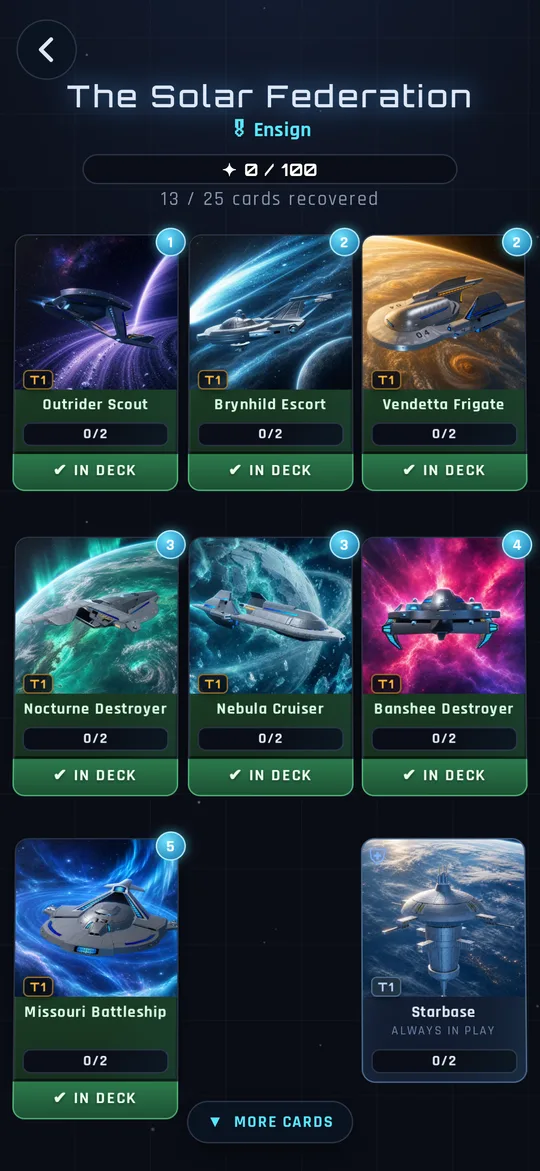
Card types to build with
| Type | What it does |
|---|---|
| Beam ships | Short range, fire instantly. Brawlers and escorts. |
| Torpedo boats | Long range and heavy hits, with a reload between salvoes. |
| Carriers | Stand off and launch fighter wings that do the fighting. |
| Freighters | Unarmed. Mine ore deposits and haul fuel home for bonus energy. |
| Minefields | Laid on the board; enemy ships crossing them strike mines. |
| Skills | One-off effects such as an ion storm that drags ships aside or a missile salvo from your homeworld. |
| Specialists | Cloakers, raiders that capture ships, a destroyer that strips cloaks, an alchemy ship that turns wrecks into energy. |
A collection that is earned
You start with three races and a starter set for each. Winning pays chests; chests pay blueprints and megacredits; new hulls appear as you climb the 27-rank officer ladder with each race. Blueprints also raise a ship's tech level, which fits it with better weapons and shields.
Chests are only ever won or given free. The store does not sell them. The details are here.
Why a small deck makes better decisions
In a sixty-card deck, the fifty-eighth card is rarely an agonising choice. In a seven-card deck there is no fifty-eighth card. Adding a Loki to deal with cloakers means dropping your second cheap ship, and you will feel its absence in every match where the opponent is not cloaking. That trade-off is what the deck building is.
Questions people ask
Is Skyfire a deckbuilder like Slay the Spire?
No. Slay the Spire is a single-player game where you build a deck during a run. Skyfire is a competitive real-time game where you build a small deck from your collection before the match.
How many cards are in a Skyfire deck?
Seven, each of them different, all from one race. Your starbase is always in play and does not use a slot. An optional eighth slot opens at Fleet Admiral rank with that race.
Can I save more than one deck?
Yes. Each race keeps its own deck, and saved decks follow your account from one device to another.
Is there a best deck?
No single one. Each race has several workable builds, and the right choice shifts with the races you keep meeting on the ladder.