Beginner's guide
How to play Skyfire
Skyfire takes about a minute to start playing and a long time to play well. This page covers everything that happens in a battle, in the order you will meet it.
The goal
Destroy the enemy homeworld. Do that and the battle ends immediately, whatever the clock says. Keep your own safe: your ships help defend it.
If neither homeworld falls in three minutes, the commander who has destroyed more bases wins. Each side has two bases: a starbase and the homeworld behind it.
The board
- Your homeworld is at your end. Its defence posts outrange everything in the game.
- Your starbase stands in front of it, with a gun battery and its own fighters.
- Two lanes run from your side to the enemy's. Each crosses the central trench by a jump-gate bridge.
- The asteroid field lies in the middle, between the lanes. Ore deposits appear there during the battle.
The enemy's side mirrors yours.
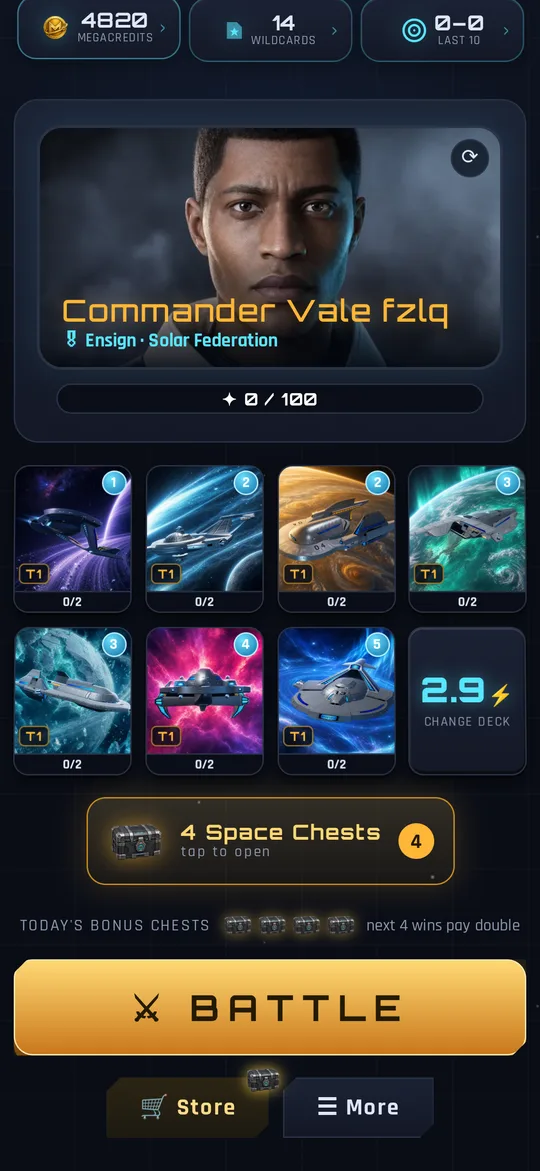
Energy and your hand
Your deck is seven cards. You hold four at a time; play one and the next comes up. Every card has an energy cost, from one to eight.
The energy bar holds up to 10. It refills on its own, and you start each battle with some already banked. In the last minute of regulation it refills twice as fast.
To launch a card: tap it, then tap the battlefield. If you tap somewhere the card cannot go, it slides to the nearest spot it can.
Where you can launch
- Warships and minefields: anywhere in your own half.
- Forward on a bridge: also allowed, in a lane the enemy starbase does not cover.
- After you destroy the enemy starbase: that flank of the enemy's half opens to you.
- Freighters: only at the back, near your homeworld.
- A few special cards: hyperjump ships and skills such as the Ion Storm or Missile Salvo go anywhere.
What ships do once launched
You do not steer. A ship flies down its lane, picks targets and fights by itself. Your control is the choice of card, place and moment.
Every ship is different: speed, weapons and toughness all vary. Three kinds of weapon matter:
| Weapon | Range | Behaviour |
|---|---|---|
| Beams | Short | Fire instantly. Also what sweeps minefields. |
| Torpedoes | Long | Hit hard, travel visibly, then reload. |
| Fighters | Longest | Launched by carriers and starbases; fly out, attack, return. |
Above each ship is a readout. Blue is shields, counting down. Red is hull damage, counting up to 100. A damaged ship that still has shields shows both.
Freighters: the second way to get energy
Freighters bring energy. A freighter flies to an ore deposit in the asteroid field, loads fuel and hauls it home, and each load adds to your energy bar. Over a match, two working freighters are worth a lot of extra ships.
They are unarmed. Protect them. And when you see the enemy's, remember that killing a freighter is often worth more than damaging a starbase.
How a battle ends
- A homeworld is destroyed. Instant win, at any time.
- The clock reaches zero. More bases destroyed wins.
- Level at zero: overtime. Sudden death. The first base to fall ends it. There are two one-minute periods, the second at triple energy.
- Still level: the side whose worst-damaged structure is in worse shape loses.
Six mistakes every new commander makes
1. Sitting on a full energy bar
Energy above 10 is simply lost. If your bar is full and nothing is on the board, you are wasting it. Play something.
2. Sending ships in one at a time
A lone ship meets the whole defence alone. Launch a second card while the first is still crossing, in the same lane, so they arrive together.
3. Opening with a freighter and nothing else
An unescorted freighter is a gift. Put a warship out first, or at least alongside.
4. Chasing both lanes
Splitting your energy evenly usually means losing both. Defend one lane cheaply and push the other hard.
5. Ignoring the clock
Keep an eye on it. When double energy starts, the ships you could not afford are suddenly affordable, for both of you. Have a plan for that minute.
6. Playing the heavy ship with nothing in front of it
A battleship does its best work when something cheap is drawing fire ahead of it. Placement and timing matter: choose where, and when, to launch.
After the battle
A win pays a chest. A loss still pays megacredits. Chests hold blueprints; collect copies of a ship, then spend megacredits to upgrade it. On the fleet screen, the seven cards marked IN DECK are the ones that go into battle, and you can swap them freely.
Wins also earn merit, which promotes you through 27 ranks from Ensign upward. Promotions pay better chests, open new hulls, and at certain ranks let you unlock another race.
Questions people ask
Do I control the ships after launching them?
No. Once launched, a ship flies, chooses targets and fights on its own. You decide which card to play, where and when.
Can I launch ships on the enemy side of the board?
Not at first. You can launch in your own half and on a bridge the enemy starbase does not cover. Destroying the enemy starbase opens that flank, and a few hyperjump ships and skills can go anywhere.
What is the starbase card in my deck?
It represents your starbase and homeworld. It is always in play, costs nothing and does not take one of your seven slots. Ranking up strengthens both.
Is there a tutorial?
Yes. Your first battles are guided: the game highlights a card to play and a place to put it until you have found your feet.